










A data center is measured by availability. A power outage of a few minutes can cost its customers more than the entire backup infrastructure, so every serious data center keeps a generator farm capable of carrying the whole site for hours to days. In this article we explain how such a system is built, what an N+1 configuration means, and why it is usually the fuel infrastructure, not the generator itself, that decides whether the backup will work when needed.
What happens the moment the power fails
When grid power is cut, the uninterruptible power supply (UPS) systems carry the load on batteries for seconds to minutes. In that time the generators start, reach stable speed and voltage, and the automatic transfer switch (ATS) moves the load onto them. The whole process should complete within seconds. From there the generators carry the site until the grid returns, or until the fuel runs out.
N+1 configuration: redundancy that allows maintenance
The letter N stands for the number of generators needed to carry the site's full load. An N+1 configuration means one generator more than required, so that even when one unit is down for maintenance or fails, the farm still delivers full power. Data centers at higher availability tiers work in even stricter configurations, such as 2N (two complete, separate systems).
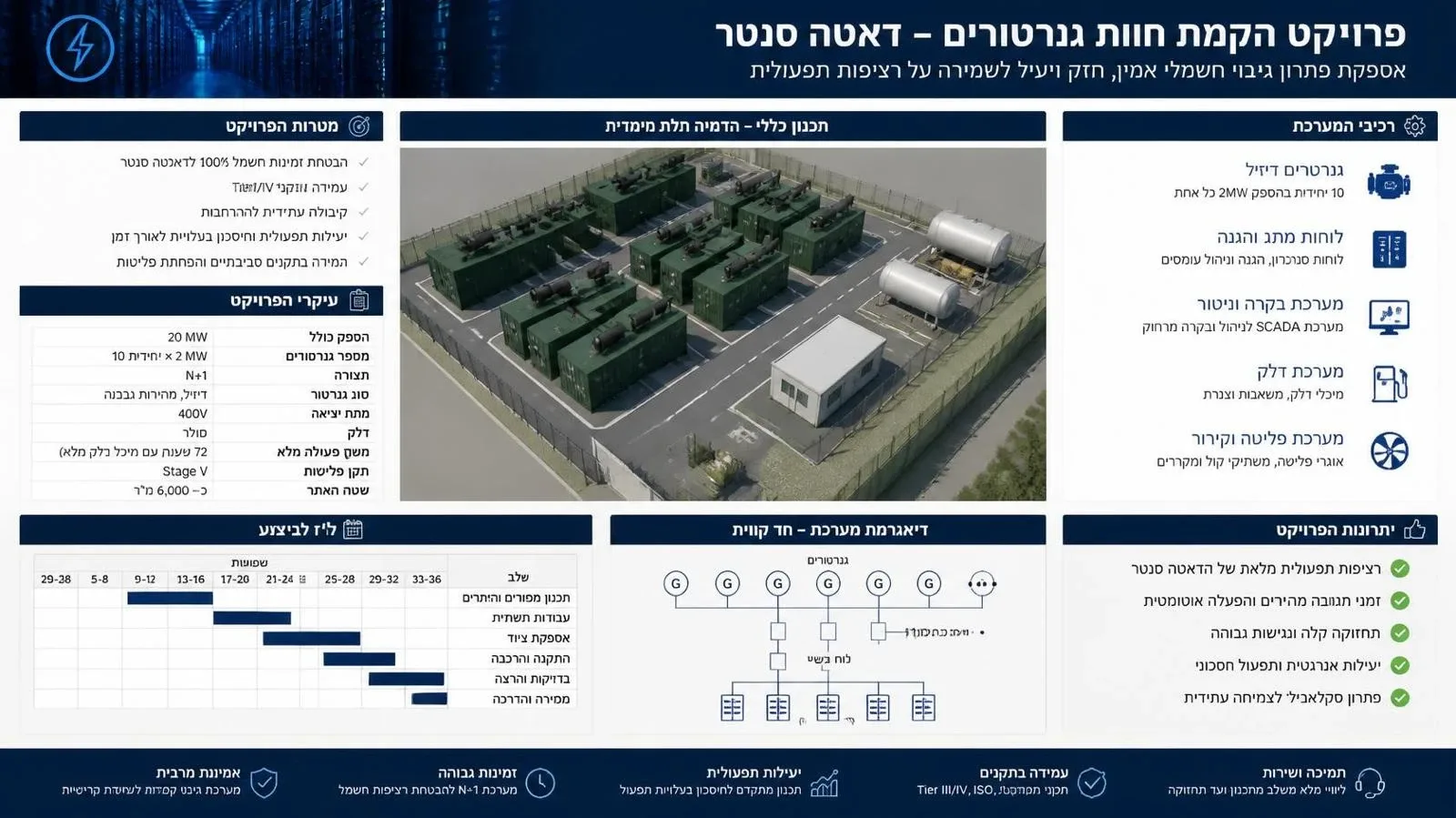
For example, a site that draws 18 MW can be built from ten 2 MW units: nine for the load and one in reserve. The units are synchronized through synchronizing panels and main switchboards, and the control system decides which units run and at what load.
The fuel infrastructure: where most projects fail
A generator without fuel is scrap iron. A generator farm is usually designed for a defined run time at full load, typically between 24 and 72 hours, and the storage volume follows from that. Ten 2 MW units at full load burn thousands of liters of diesel per hour, so we are talking about hundreds of thousands of liters of on-site storage.
Main tanks
Main storage is in double-wall underground tanks or in above-ground tanks inside a containment bund. The considerations are similar to a fuel station: preventing soil contamination, leak monitoring, fill points accessible to tankers, and venting. The difference is in scale and in the availability requirement: filling must be possible while the farm is running.
Day tanks and feed piping
Next to each generator, or inside its container, sits a small day tank that feeds the engine directly. Transfer pumps fill the day tanks from the main tanks through feed piping, usually in a redundant configuration: two pumps and two lines, so that a single failure does not cut off the feed. The piping is double-wall, with leak detection, and designed so that every unit can receive fuel from any main tank.
Fuel quality
Diesel that sits in a tank for months absorbs water, grows microbial contamination and forms sediment. A generator started in an emergency on contaminated fuel will stall on clogged filters. So a generator farm includes a fuel polishing (filtration and circulation) system and a schedule of periodic fuel tests.
Control, monitoring and testing
A central control system (SCADA or a building management system) tracks the status of every unit, the fuel levels in every tank, temperatures, faults and leak alarms, and allows remote operation and control. But control does not replace testing:
- Periodic exercising: Starting every unit at fixed intervals, even without a power outage.
- Load bank test: Running at full load against an artificial load, to verify that the units and the fuel hold up.
- Full transfer test: A deliberate disconnection from the grid and transfer to the generators with the site's real load.
Emissions, noise and the environment
Dozens of large diesel engines are a significant source of emissions and noise, even if they run only a few hours a year. The farm's design addresses the engines' emission standards, the height and location of the exhaust stacks, silencers and acoustic enclosures, and the distance from sensitive buildings. All of these affect the infrastructure work: bases, trenches, foundations for the containers and the cooling systems.
What is required of the infrastructure contractor
| Field | Main works |
|---|---|
| Earthworks & Site Development | Site preparation, excavation for tank pits and pipe trenches, controlled backfill, drainage |
| Bases and structures | Concrete bases for containers and tanks, containment bunds, control building, fencing |
| Fuel tanks | Setting, anchoring, connection, tightness tests, fill and vent systems |
| Feed lines | Double-wall piping, transfer pumps, day tanks, pressure tests and documentation |
| Coordination | Working with the electrical consultant, the generator supplier, the environmental consultant and the regulators |
FAQ
How many hours of operation is the fuel storage designed for?
It is set by the site's availability tier, by the emergency fuel supply agreements, and by the client's requirements. A common range is 24 to 72 hours at full load, with the site relying on tanker deliveries beyond that.
Underground or above-ground tanks?
Underground tanks save space and are better protected from impact and heat, but they require excavation, anchoring and stricter monitoring. Above-ground tanks are cheaper to install and maintain, but require a containment bund, impact protection and sometimes active fire protection. The choice depends on the site, the soil and the safety requirements.
What is the difference between fuel infrastructure for a data center and a fuel station?
The technology is similar: double-wall tanks, piping with leak detection, monitoring. The differences are the far larger volumes, the redundancy required in every component, and the fact that the fuel sits for a long time rather than turning over every day. So fuel station experience is highly relevant, but the design has to fit the availability world of data centers.